
How Much Does It Cost to File for Workers’ Comp in Virginia?
Published by Corey Pollard | Last Fact-Checked: March 3, 2026
How much does it cost to file workers’ comp in Virginia?
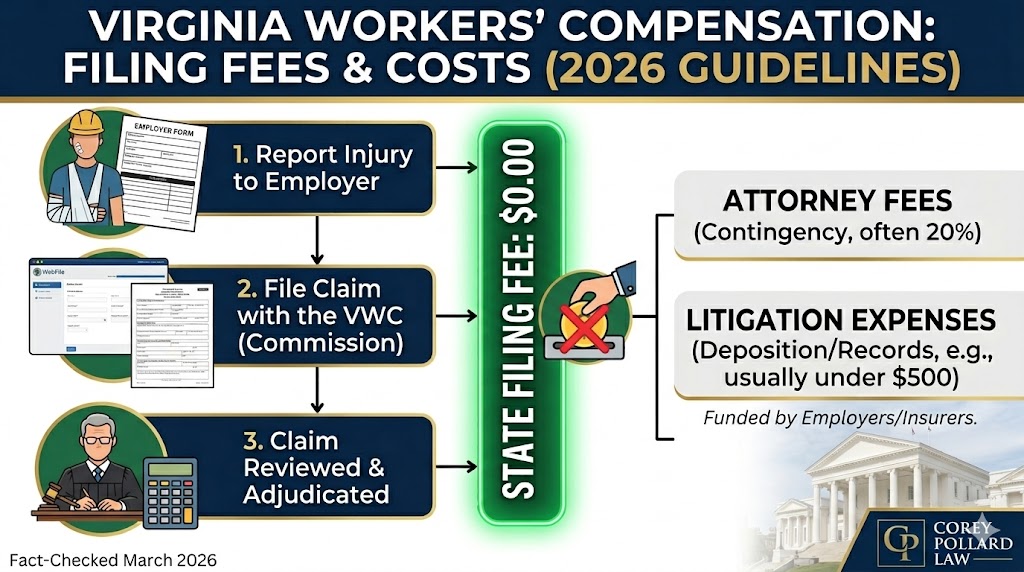
$0. Filing a workers’ compensation claim with the Virginia Workers’ Compensation Commission costs nothing. The Commission does not charge injured workers any filing fee, court cost, or service-of-process fee related to the initial claim or change-in-condition applications.
It costs exactly $0 to file a workers’ compensation claim in Virginia. Under the Virginia Workers’ Compensation Act, there are no filing fees, court costs, or service of process charges for injured employees. The system is funded entirely by employers via insurance premiums, and Virginia Code § 65.2-807 strictly prohibits employers from deducting these costs from your paycheck. While litigation expenses for medical records or expert reports may arise if a claim is denied, most Virginia workers’ comp attorneys – including Corey Pollard Law – operate on a 20% contingency fee, meaning you pay nothing upfront and only owe a fee if you win your case or reach a settlement. Simply submit your Claim for Benefits form (also called a Request for Hearing) to the Virginia Workers’ Compensation Commission, and that’s it – you have an official claim.
Key Takeaways: Workers’ Comp Filing Costs in Virginia
Filing fee: $0. No filing fee, no court costs, no service of process fees.
Attorney fees: $0 upfront. Workers’ comp lawyers work on contingency – typically 20% of the settlement or 15–20% of accrued benefits won at hearing. You pay nothing unless you recover benefits.
Litigation expenses: Rarely exceed $500; usually under $200. These cover medical records, doctor reports, and depositions if the insurer denies your claim. Many cases have no litigation costs at all.
Who funds the system: Your employer. Virginia Code § 65.2-807 makes it illegal for employers to deduct workers’ comp insurance costs from your paycheck.
Many injured employees who call my office show surprise – and joy – when they find out there is no cost to file for workers’ compensation benefits. From past experiences or conversations with friends and family, they know that cases in civil and criminal courts often involve filing fees or court costs, so they assume workers’ comp has similar costs. It doesn’t. As part of its stated purpose to compensate injured employees who cannot work due to occupational injuries and diseases, Virginia’s workers’ compensation system offers a zero-cost filing process.
If concerns about costs are keeping you from filing for workers’ compensation benefits, keep reading. I’ll clarify what you will and won’t pay, from initial filing to attorney fees and litigation expenses. Call or text me at (804) 251-1620 if you’d rather talk through it.
Workers’ Comp vs. Civil Court: The Filing Fee Difference
Here’s the first area where costs between workers’ comp claims and civil actions is stark.
If you seek damages in a Virginia circuit court for injuries in a car crash, truck accident, or due to a defective product, you must pay a filing fee to pursue your legal rights.
Virginia Code § 17.1-275 details the applicable filing fees. The cost depends on the award of monetary damages sought in the lawsuit:
-
- Up to $49,999 in damages: $100 filing fee
- $50,000 to $100,000: $200
- $100,001 to $500,000: $250
- Over $500,000: $300
In addition to these filing costs, Virginia Code Section 17.1-278 allows courts to tack on a $10 fee if the city or county where you file provides civil legal representation for impoverished individuals, without charge, by a nonprofit legal aid program organized by the Virginia State Bar. And Virginia Code Section 17.1-279 allows circuit courts to assess a $5 fee for the “Technology Trust Fund.”
Further, you must pay the sheriff or a private process server to “serve” the lawsuit on each defendant. These fees can add $50 to $200 to the amount you must pay to file a lawsuit.
| Cost Category | Workers’ Comp Claim | Civil Court Lawsuit |
|---|---|---|
| Filing fee | $0 | $100 – $300 |
| Court costs / surcharges | $0 | Up to $15 |
| Service of process | $0 | $50 – $200 per defendant |
| Attorney fee structure | Contingency (20% of recovery) | Contingency (33–40% of recovery) |
| Typical time to hearing/trial | 3 – 4 months | 12+ months |
| Total upfront cost to file | $0 | $150 – $515 |
As you can see, a serious personal injury case involving traumatic brain injury or the need for surgery can easily cost you $300 to $500 to get through the courthouse door.
Workers’ compensation costs? Zero. Nothing. You don’t pay a dime to file your claim.
The ability to seek workers’ compensation benefits without paying filing costs is a win for employees. I’ve talked to many injured workers who waited months to call an attorney because they thought they’d have to pay several hundred dollars to file a claim and couldn’t afford it while out of work or facing medical bills. I even saw this hesitation to file when I represented insurance companies before switching to plaintiffs’ work. Insurance carriers loved this delay. It allowed them to hold on to their money longer. Don’t give them this advantage.
How to File
The Workers’ Compensation Commission accepts claims in four ways, and none of them cost you anything:
Online – through the Commission’s WebFile system. The Virginia Workers’ Compensation Act requires employers and claim administrators to report injuries to the Commission. Once the Commission receives notice of your injury, it will create a file and assign a Jurisdiction Claim Number (JCN). You can access your electronic file by requesting a PIN from the Commission and use the pre-formatted documents to file your initial claim for benefits free of charge. This filing method is the fastest.
By fax – send your completed Claim for Benefits form to (804) 823-6956.
By mail – send it to Virginia Workers’ Compensation Commission, 333 E. Franklin St., Richmond, VA 23219. I’d recommend certified mail with return receipt if you go this route, especially if you’re anywhere near the two-year statute of limitations.
In person – walk it into any VWC regional office. Bring your photo ID.
Why It Costs Nothing to File for Workers’ Compensation
The reason it costs nothing to file for workers’ compensation benefits dates back to the establishment of workers’ comp systems in states across the country.
Workers’ comp is known as the “grand bargain.” Employees gave up the right to sue their employers for negligence. In exchange, legislatures created workers’ compensation systems to make it easier – not harder – to receive benefits (wage loss, lifetime medical treatment, and permanent partial disability) after a workplace injury. Charging filing fees would undermine that trade-off and punish workers who are already losing money and worried about medical bills.
You can see this structural difference when comparing the time it takes to go to trial and receive compensation between workers’ compensation and personal injury litigation. In a personal injury case in civil court, you will likely wait more than a year for a trial date after paying your filing fee. In comparison, you will likely get a workers’ compensation hearing date within three to four months of filing your claim with the Commission. And in some situations, a hearing is unnecessary because the employer and its insurer acknowledge compensability and enter into an award of benefits.
What About Attorney Fees?
No upfront cost. Workers’ compensation attorneys in Virginia, including my firm, Corey Pollard Law, work on a contingency-fee basis. That means I get paid a percentage of the benefits I help you win or the settlement payout I negotiate for you. If I don’t recover anything, you don’t owe me a fee.
The Workers’ Compensation Commission regulates these fees. In most cases, attorney fees break down like this:
-
- Settlement cases: 20% of the gross settlement amount is standard
-
- Accrued benefits (hearing wins): typically 15 to 20% of past due benefits, depending on the case’s complexity
-
- Cases where you already had a settlement offer before hiring a lawyer: the fee may apply only to the amount above the pre-existing offer
Let me put real numbers on it. Say you hire me and I negotiate a $100,000 workers’ comp settlement for your back injury. A 20% attorney fee means $20,000 goes to my firm. You receive $80,000 – which, by the way, is not taxable income. That $80,000 is yours. Uncle Sam and the Commonwealth of Virginia do not get any of it.
Now, does 20% feel like a lot? I’ve had clients tell me that before we started working together. Then I negotiated a settlement five times higher than the insurance company’s initial offer. The math tells the story. One 2018 study found that injured employees with attorneys recovered nearly three times as much as those without representation. Even after the fee, you often end up significantly ahead. I cannot remember a single instance where that hasn’t been the case for one of my clients.
If you’re still on the fence about whether hiring a lawyer is worth the cost, read my analysis of when you should hire a workers’ comp attorney. And if you want to understand the full terms before hiring anyone, read my breakdown of the workers’ comp retainer agreement and what to look for.
Litigation Expenses: The One Area Where Costs Can Come Up
Filing the claim is free. Attorney fees come out of your recovery. But there’s a third category – litigation expenses – that you should understand before your case gets moving.
If the insurer denies your claim and you head to a hearing, there may be costs involved in building a winning case. Copies of medical records, narrative reports from doctors on causation and disability (work restrictions), permanent impairment evaluations, deposition transcripts, and expert witness fees, to name a few. These aren’t attorney fees. They’re the costs of proving your case when the insurer denies your entitlement to benefits.
How these expenses get handled varies by firm. Some lawyers advance them and deduct the costs from your settlement at the end. Other law firms ask clients to reimburse certain expenses along the way. My retainer agreement spells out how we handle litigation costs, and I explain it during our first conversation. You will never be surprised.
Fortunately, most workers’ comp claims don’t involve significant litigation expenses. Usually, costs are limited to medical records requests, a phone conference with a doctor, a narrative report from a doctor, and a few depositions. You don’t have to worry about the kind of expert witness costs that pile up in civil trials, where you need live testimony from everyone.
In fact, it’s rare for the total costs in a workers’ compensation case to exceed $500. Workers’ comp is an administrative system designed to be faster and cheaper than state or federal circuit or district courts.
Have questions about the cost of hiring a workers’ comp attorney? Call (804) 251-1620. The initial consultation is always free, and my firm will call you back within 24 hours.
Who Actually Pays for Workers’ Comp?
You might be wondering: if the employee doesn’t pay filing fees, and the attorney only gets paid if the case wins, who’s funding this system?
Your employer. Under Virginia law, employers bear the full cost of workers’ compensation insurance premiums. They can’t deduct a single penny from your paycheck for this coverage. Virginia Code § 65.2-807 makes it illegal for an employer to require employees to contribute toward workers’ comp insurance costs. If your employer has suggested otherwise, that’s a red flag — and potentially a violation of Virginia law.
The whole system runs on a trade-off. Employers accept financial responsibility for workplace injuries. Employees, in return, give up the right to sue their employer in civil court (with limited exceptions involving third-party negligence). The result is a process that gets injured workers benefits without filing fees, without proving negligence, and without the expense and delay of a jury trial.
Summary: What You’ll Actually Pay for a Virginia Workers’ Comp Claim
From start to finish, here is what a Virginia workers’ compensation claim costs the injured worker: nothing to file, nothing upfront for attorney fees, and – in most cases – less than $500 in total litigation expenses that come out of any recovery. The employer funds the entire workers’ compensation insurance system. The Virginia Workers’ Compensation Commission charges no filing fees. And contingency-fee arrangements mean your attorney only gets paid when you do.
Don’t Let Imaginary Costs Keep You from Filing and Recovering Benefits for Your Work Injury
I’ve represented injured workers across Virginia for over 15 years, and I’ve lost count of how many anxious potential clients have asked about filing costs. Here’s the truth: You cannot afford not to file a claim. And it’s free.
Filing costs you nothing. A consultation with my office costs you nothing. And if I take your case, you pay nothing until I recover benefits or a settlement for you.
When I was defending insurance companies, the single most valuable thing – from the insurer’s perspective – was an injured worker who waited too long. Delayed accident reporting, delayed treatment, stale evidence, and missed deadlines. That’s what carriers bank on. A two-year statute of limitations applies to workers’ compensation cases. Don’t be the person who hands them that advantage because you assumed it would cost money to get started.
Call (804) 251-1620 or text me. The consultation is free, and I’ll tell you exactly where your case stands.
