
Virginia Nurses and Healthcare Workers Can Win Workers’ Comp for COVID-Era PTSD
If you are a Virginia nurse or healthcare worker who developed PTSD, major depressive disorder, or another mental health condition from working during the COVID-19 pandemic, you may be entitled to workers’ compensation benefits – even if your employer denied your claim, even if you had prior mental health treatment, and even if you have already returned to work in some capacity.
The Court of Appeals of Virginia recently affirmed a workers’ compensation award for my client, a registered nurse at Inova Alexandria Hospital who developed PTSD and major depressive disorder from caring for critically ill COVID-19 patients. Inova Alexandria Hospital, et al. v. Santora, Record No. 1837-24-2 (Va. Ct. App. Mar. 24, 2026). The court found no error in the Commission’s decision. My client gets compensated. Here is what that means for you.
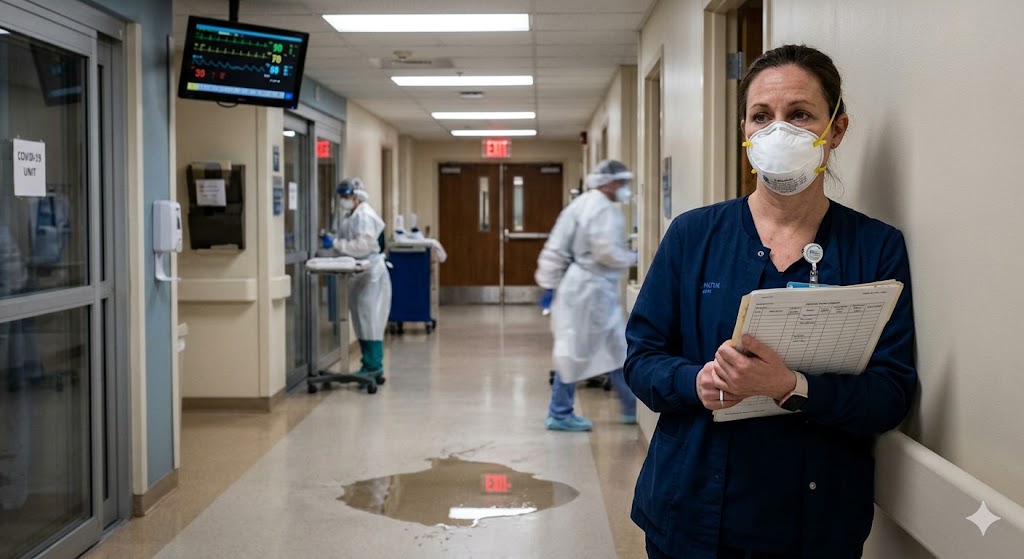
Can PTSD from COVID exposure at work be covered by workers’ comp in Virginia?
Yes. PTSD and major depressive disorder can qualify as compensable “ordinary diseases of life” under Virginia Code § 65.2-401 if:
-
- The condition arose from your work.
-
- The conditions were peculiar to your job.
-
- Your testimony or medical providers can connect your diagnosis to your work.
The Virginia Court of Appeals recently affirmed compensation for a nurse who met this standard in Inova Alexandria Hospital v. Santora, Record No. 1837-24-2 (Va. Ct. App. Mar. 24, 2026).
Your PTSD Can Be Compensable Even If Your Employer Argues It Comes from Stress Over the Pandemic
That is the core holding of this case, and it is the argument every Virginia employer and carrier will make against you.
Inova’s defense was that my client’s PTSD arose from generalized stress about the pandemic — the kind of anxiety anyone might feel during COVID-19. If that argument works, the claim fails. A disease that any member of the public could develop is not specific enough to any particular job to qualify for workers’ compensation benefits.
The Workers’ Compensation Commission rejected that argument. The Court of Appeals affirmed.
What distinguished my client’s PTSD from ordinary pandemic anxiety was the specificity of what she experienced at work. She was a postoperative surgical nurse helping healthy patients recovering from planned procedures. When the pandemic began, Inova converted her unit overnight to treat COVID-19 patients. She had no training in respiratory care. She had no adequate personal protective equipment. She was assigned housekeeping, maintenance, and IT duties in addition to her nursing responsibilities, specifically to reduce the number of people on the floor. She escorted patients to the ICU for intubation. She watched people suffer, one after another, in ways she was not prepared for and had never encountered in her prior nursing experience.
None of that is general pandemic stress. That is a specific nurse, in a specific unit, doing work her training never contemplated, without protection, without a meaningful ability to decline. The Commission found those conditions peculiar to her employment. The court agreed.
How Virginia Workers’ Compensation Law Covers Mental Health Conditions
Virginia’s Workers’ Compensation Act does not cover mental health conditions arising from ordinary workplace stress. To recover, a mental health diagnosis must qualify as an “ordinary disease of life” under Code § 65.2-401 – and that requires proof by clear and convincing evidence on two elements.
The first element is that the disease arose out of and in the course of employment and did not result from causes outside the employment.
The second element is that the disease is characteristic of the employment and caused by conditions peculiar to that employment.
That second element – “peculiar to employment” – is where these cases are won or lost. It is the legal mechanism that separates compensable occupational disease from ordinary life stress for which you cannot recover benefits. The word “peculiar” does not mean unique or unprecedented. It means that the conditions causing the disease are characteristic of this particular employment in a way that distinguishes them from what the general public encounters.
For my client, the Commission found she satisfied that standard by clear and convincing evidence. Multiple treating providers – a psychiatrist, a psychiatric physician assistant, and a mental health therapist – each independently drew direct causal connections between her work conditions and her PTSD and depression. Her own testimony described the specific ways her job changed, the specific things she witnessed, and the specific fears she carried about infecting her postsurgical patients with COVID-19 while being repeatedly floated to COVID units against her concerns.
That is the record that wins this type of case.
Two Defense Arguments the Court Rejected – And Why They Matter
Inova raised two arguments on appeal that you will see in virtually every mental health workers’ compensation case in Virginia. Understanding why they failed is as important as understanding why my client won.
The outside-causes argument. Inova argued that my client’s conditions arose from stressful events outside the workplace. There was some evidence to work with – she had a history of anxiety treatment dating back some years. The court acknowledged that evidence existed and affirmed the Commission anyway.
The reason: the Court of Appeals does not reweigh evidence. It defers to the Commission’s factual findings when credible evidence supports those findings. Where the Commission credited multiple treating providers who causally connected her PTSD and depression to her work, and where a reasonable mind could conclude from that evidence that her conditions arose from employment, the appellate court will affirm that finding. Springfield Pest v. Peterman, 82 Va. App. 668, 679 (2024).
The specific-exposure-date argument. Inova also argued that my client had to prove specific COVID patient contact on the exact dates of her panic attacks. The court disposed of this cleanly: Inova cited no legal authority for that requirement because none exists. Occupational causation in a mental health case is analyzed based on the totality of work conditions over time, not a single triggering event pinned to a calendar date. That is the right framework, now affirmed at the appellate level.
What a Prior Mental Health History Does – and Doesn’t – Do to Your Claim
This is the question I hear most often from healthcare workers who are afraid to file. They had therapy before the pandemic. They were on medication. They had a prior anxiety diagnosis. They assume that history bars them from recovering.
It does not bar the claim. It complicates it, but it does not end it.
My client had prior anxiety treatment. She had never been diagnosed with PTSD or major depressive disorder before the pandemic. The disabling diagnoses – the ones that caused her to stop working – were new, and causally connected to her work.
That distinction is critical. The question is not whether you had any mental health history before COVID. The question is whether your current disabling diagnosis is new, whether it arose from your work conditions, and whether your treating providers are willing to say so.
What you need is what my client had: medical providers who will draw a clear, direct causal connection between your specific work conditions and your specific current diagnoses. Not general stress. Not pandemic anxiety. A medical opinion that traces this degree of PTSD, this level of depression, this disability from work, to the conditions of this job.
Who This Decision Helps
The legal principles from Santora extend beyond the COVID-era nursing context.
Any Virginia healthcare worker who developed a diagnosable mental health condition from occupational exposure to mass suffering during the pandemic – nurses, respiratory therapists, emergency department technicians, paramedics, ICU physicians – should evaluate this decision carefully before assuming their claim cannot succeed. Additionally, any nurse or healthcare worker exposed to suffering atypical of their regular duties may have a claim.
The factors the Commission and court credited in this case:
-
- Duties outside normal scope. The hospital converted the unit to a whole new purpose for which my client had no training.
- Density and severity of exposure. Not incidental contact with a sick patient. Full-shift immersion in critically ill and dying patients.
- Inadequate protection. PPE concerns were raised, documented, and unaddressed by the employer.
- Strong medical corroboration. Separate treating providers independently connected her diagnoses to her work. Multiple diagnoses. A multi-year treatment course.
- New disabling diagnoses. The preexisting anxiety was a different condition. The PTSD and MDD that disabled her were new.
If your situation reflects those factors, the Commission has affirmed, and the Court of Appeals has upheld that your claim is the kind of claim Virginia law is designed to compensate.
The Clock Is Running
Virginia’s workers’ compensation statute of limitations applies to occupational disease claims. The two-year limitations period generally begins when you receive the diagnosis, not when you were exposed to the condition.
If you developed COVID-era PTSD, major depressive disorder, or panic disorder and have not yet filed a claim, the window to act may be closing.
The disability compensation in this case covered more than a year of total and partial disability between 2020 and 2023, plus a lifetime medical award for treatment of the occupational diseases. That result – ongoing access to psychiatric care, wage replacement during the period of disability – is the difference between a healthcare worker who can get treatment and one who cannot.
Talk to a Virginia Workers’ Compensation Attorney
I litigated this case from the initial hearing before the deputy commissioner through the full Commission and the Court of Appeals. I understand how to build these claims, what the Commission looks for, and how to fight the arguments Inova raised – the same arguments every employer and insurance carrier in Virginia will make against you if they can.
If you are a Virginia nurse or healthcare worker who developed a mental health condition from your work during the COVID-19 pandemic, I want to hear from you. The consultation is free. The fee is contingent on winning or negotiating a settlement. You pay nothing unless we recover.
Free Consultation — No Fee Unless We Recover
Call Corey Pollard Law: (804) 251-1620 or (757) 810-5614
Corey Pollard | Corey Pollard Law | Jenkins, Block & Associates, P.C. | Richmond, Virginia
The Court of Appeals designated this opinion as unpublished under Code § 17.1-413(A). It does not carry binding precedential authority. It remains persuasive evidence of how the Commission and the Court currently analyze COVID-era mental health claims under § 65.2-401 and is directly relevant to cases presenting similar facts.

- Can You Get Workers’ Comp for PTSD from COVID Work in Virginia? (2026 Case Update) - March 24, 2026
- Another Win Before the Court of Appeals of Virginia - March 18, 2025
- Appellate Decision Shows the Risk of Ignoring VWC Orders - February 12, 2025

